Back to all posts
InsightsJul 16, 20265 min read
Agentic AI vs AI Voice Agents: What's the Difference?
Divyang Mandani
Founder & CEO
Founder & CEO
Thousands of companies now put the word "agentic" on their product page. Gartner's count of how many are genuinely doing agentic work: roughly 130. Every other vendor using the term has attached it to something that already existed. So when you sit through four demos and cannot articulate what separated them, the problem is not your attention span. Roughly 129 out of every 130 pitches you hear are describing the same thing in newer clothes.
The confusion in agentic AI vs AI voice agents comes from a hidden assumption: that the two words sit on one scale, with a voice bot at the cheap end and an agentic system at the expensive end. They do not. Agentic AI describes how much of a job a system finishes when nobody intervenes. An AI voice agent describes the fact that the job arrives by phone. A system can be one, the other, both, or neither, and the four combinations have wildly different price tags and outcomes.
I run OnDial, and my team has shipped voice AI into Indian call flows long enough to watch this specific confusion cost people real money. Below I will separate the two terms, run one ordinary phone call through three different systems so you can see the difference rather than read it, and hand you the questions that end any vendor conversation quickly.
Search this question, and you get five articles that all answer it the same way: here is definition A, here is definition B, here is a table, pick one. The table is usually accurate and almost always useless, because it compares things that were never alternatives to each other.
"Is it agentic?" asks what happens when the conversation leaves the map. "Is it a voice agent?" asks whether the conversation happens out loud, over telephony, in real time. Those are independent axes, and treating them as one line is how buyers end up paying for autonomy and receiving a phone menu.
Think about how you would describe a new colleague. "She works over the phone" and "she handles things without being asked twice" are both true, both useful, and neither is a version of the other. Nobody would ask which one you would rather hire.
Language this loose does not persist by accident. It persists because a vague word lets a vendor point at a demo that sounds impressive and let you supply the interpretation yourself. Your enthusiasm does the selling.
Gartner's most recent CIO research found that around 17% of organisations have actually put AI agents into production, while north of 60% expect to inside two years. Read that as a market where most buyers have never operated the thing they are about to purchase. Inexperience is what the vocabulary feeds on.
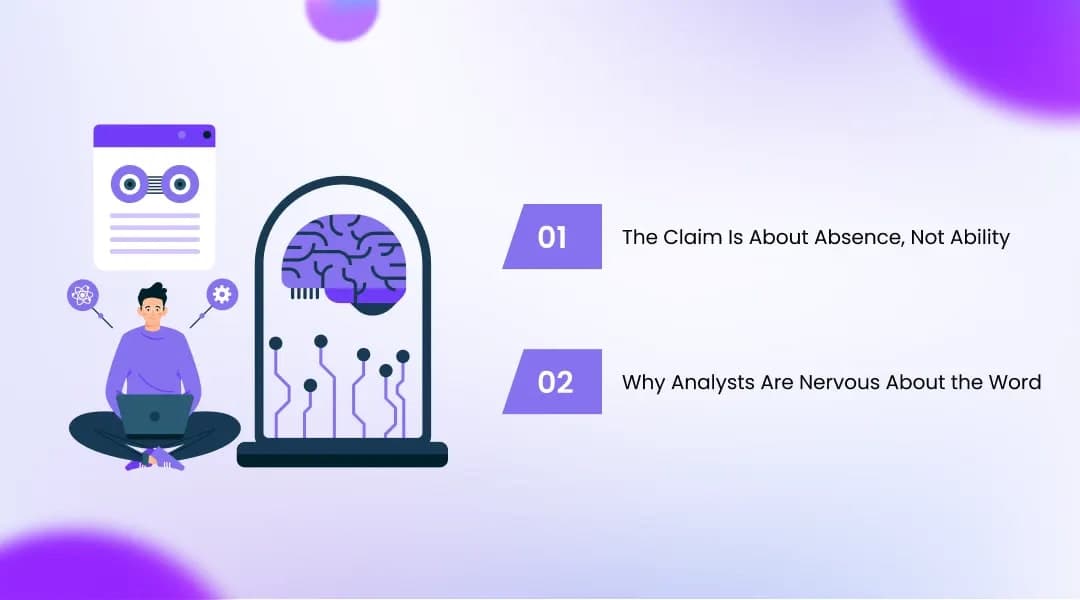
Agentic AI is a system that holds a goal, decides its own steps toward that goal, and keeps working when conditions change, without a person supplying the next instruction. Nothing in there is about speech, tone, or interface. It is a claim about behaviour under uncertainty.
Here is the part most explainers miss. Agency is not measured by what a system can do; it is measured by what it does in your absence.
Any decent model can list the steps to reschedule an appointment. The agentic question is whether it notices the slot it wanted is gone, checks the next three, confirms against the patient's stated preference, writes the change, and verifies it landed. The working definition analysts use is a system that plans multi-step work, reaches for tools and APIs, and moves toward an outcome under light supervision, held together by memory and guardrails. Take away the guardrails, and you do not have agency; you have exposure.
The category currently sits at the peak of the hype curve, which is not a compliment. Gartner expects north of 40% of agentic AI programmes to be shut down before the end of 2027, blaming runaway cost, value nobody can point to, and risk controls that were never built.
Notice that none of those three failure causes is technical. They are procurement failures. A project that started from a mislabelled product is already carrying all three on day one.
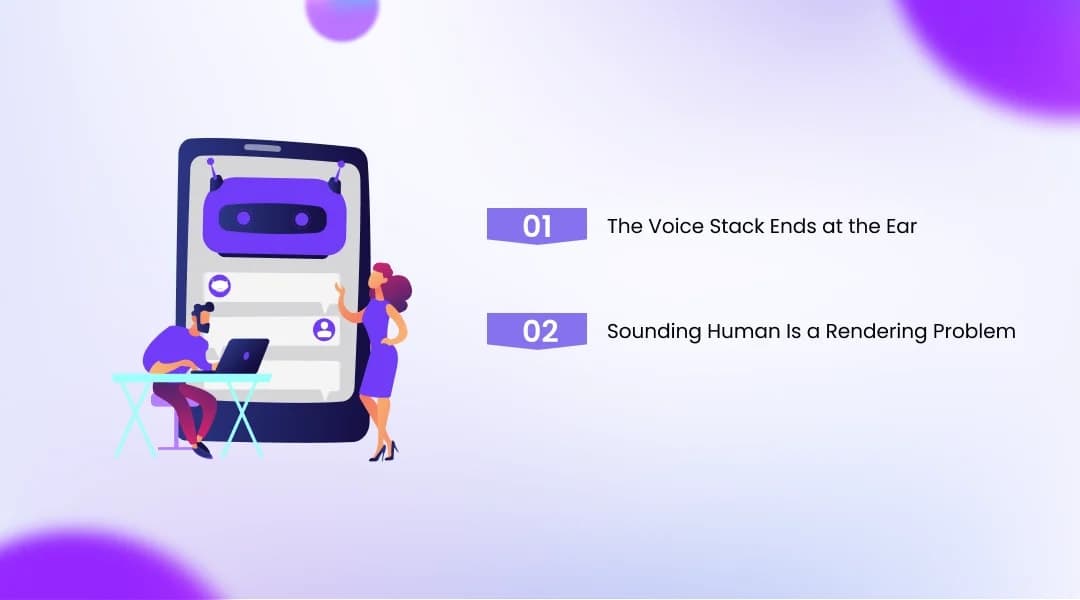
An AI voice agent is a system that talks with a caller in real time, handling interruptions and turn-taking over a live line. If you're still fuzzy on what an AI phone agent actually is, this is the foundational piece. It is a statement about the channel. It says the interaction is spoken, immediate, and unforgiving of delay.
Mechanically, a voice agent is a relay. Speech comes in via recognition and language understanding, the middle does whatever it does, and speech goes back out via synthesis, with wake word and voice activity detection policing the turns. Everything in that chain is judged on milliseconds.
What matters is that the chain is identical regardless of the intelligence in the middle. Swap a reasoning model for a decision tree and the microphone does not notice. The stack has no opinion about whether anything is thinking.
A warm, natural voice is an achievement of speech synthesis. It is downstream of every decision that actually matters, and it correlates with nothing.
I have heard rigid phone menus with gorgeous voices and genuinely capable systems that sound like a fax machine clearing its throat. Buyers consistently read voice quality as evidence of intelligence, and it is closer to the opposite: a beautiful voice is the cheapest part of the build-to-buy.
A system that sounds human and thinks like a form is the most expensive mistake in this market.
Enough definitions. Here is one ordinary call, run three ways.
A patient rings a diagnostic lab in Ahmedabad at 8:40 pm. She wants to move tomorrow's fasting blood test to Saturday. Halfway through the sentence, she switches to Hindi, then asks whether the fasting rule still applies if the slot moves to the afternoon, then circles back and asks if her earlier report has come in yet.
That is not an edge case. That is Tuesday.
A phone menu with a good voice. It catches "reschedule," offers slots one through four, and loses her entirely at the fasting question. She presses zero. The system has automated the greeting and nothing else.
A conversational voice agent. It follows every turn, answers the fasting question correctly, keeps up with the language switch, sounds excellent doing it. Then it says a team member will call back tomorrow to make the change. She has had a pleasant conversation, and her appointment is still wrong.
An agentic voice agent. It checks Saturday availability, finds the morning full, offers the afternoon, flags that the fasting window shifts accordingly, writes the booking, checks the report queue, confirms the report is pending, and reads back what it just did. She hangs up with the problem solved.
Three systems. One call. The difference between the second and the third is not conversation quality; it is whether anything changed in a system of record. Gartner's projection that autonomous systems will settle roughly 80% of routine service issues by 2029, cutting operating cost by about 30%, is a claim about the third system only; it's the same economic shift behind why enterprises are replacing traditional call centers with AI voice agents. The second one is a very polite receptionist for a queue.
No. A voice agent describes the channel a conversation runs on; agentic AI describes whether the system finishes the job on its own. Many voice agents are not agentic, and most agentic systems never speak at all. The pairing is optional, and a vendor who treats the words as synonyms is telling you something useful about their product.
When a reasoning layer sits behind a live phone line, the industry calls it agentic voice AI. That is what nearly every vendor means to describe when they reach for either term, and it is a genuine category, not a marketing invention.
The distinction only matters because the overlap is where the money is and where the misrepresentation happens. You are rarely choosing between the two ideas. You are checking whether the thing you were shown actually contains both.
Ask for a live call rather than a recording, then break it on purpose. Change your mind mid-sentence. Ask something adjacent. Come back to the original request three turns later.
Then ask the only question that resolves the whole thing: what did the system write to, and can you show me the record? Talking is free. A confirmed booking with a verified write-back is not.
I am about to describe my own industry unkindly, so weigh it accordingly. The blur between these terms is not linguistic drift. It has a name, and an analyst firm coined it.
Agent washing is Gartner's name for taking an existing chatbot, assistant, or process automation tool and reissuing it under the agentic banner with no real change in capability. The economics are obvious. Rewriting a landing page costs a weekend; building planning, tool access, verification, and escalation logic costs quarters.
You pay the difference either way. One version you pay upfront with your eyes open; the other you pay in month three when the "autonomous" system turns out to need a human closing every loop.
Use these on any vendor, including mine.
"Show me a call where the system got it wrong and recovered." Happy-path demos prove nothing. Recovery is the fingerprint of agency.
"What can it write to, not just read from?" Read access is search. Verified write access is agency.
"What does it do when confidence drops?" A real system has a threshold and an escalation rule. A relabelled one guesses and sounds confident doing it.
"Where does call data live, and how is consent handled under the DPDP Act?" Autonomy without governance is not a capability. It is a liability with better marketing.
The counter-intuitive result of every buying conversation I have had: the people asking for agentic AI usually need a conversational agent, and the people asking for a "simple voice bot" usually need agency. The label almost never matches the need.
Pull your last fifty inbound calls and sort them by what the caller wanted to happen. Calls that end with information delivered are handled by a conversational agent, and paying for reasoning on top of them buys you cost without outcome. Calls that end with something needing to change, a booking, a payment, a record update, need agency, or you are automating the hold music.
That sort takes one afternoon. I have watched more voice AI projects fail from skipping it than from any model limitation.
NextMSC valued India's voice AI market at about USD 153 million in 2024 and projects it near USD 958 million by 2030, growing around 35.7% a year. Fast growth, real demand, and a set of constraints that no imported stack handles by default.
Mid-sentence Hinglish is the entry requirement here, not a premium feature, which is exactly why a true multilingual AI voice agent matters more in India than almost anywhere else. The patient in that lab example switched language once and expected the system to keep pace, exactly as a human receptionist would. An agent that reasons brilliantly and mishears the language is worse than a phone menu, because it fails fluently.
Agentic AI vs AI voice agents stop being confusing the moment you accept that the two words answer separate questions: one asks what the system finishes alone, the other asks whether it happens out loud. Three things worth keeping: voice quality is evidence of nothing, agency is visible only when something goes off-script, and the record of what the system wrote is the only proof that survives a demo. You now have a test no sales conversation can pass dishonestly, which puts you ahead of most people signing these contracts this quarter.
If you would rather test that than read about it, call an OnDial agent and try to break it. Change your mind mid-sentence, switch to Hindi, ask something we could not have scripted. We would rather you find our edges on a test call than in month three.
Founder & CEO
Divyang Mandani is the CEO of OnDial, driving innovative AI and IT solutions with a focus on transformative technology, ethical AI, and impactful digital strategies for businesses worldwide.
View all articles by Divyang MandaniGet comprehensive answers to common questions about AI voice agents and how they can transform your customer service.
Don't let your customers wait on hold. Join thousands of businesses using OnDial to provide instant, intelligent customer service 24/7.
Can AI voice agents replace human agents? The 2026 data says no, but the real answer is more useful. See where AI wins, where it fails, and why hybrid wins.
AI voice agent security explained for enterprise buyers: the real risks, what SOC 2 and HIPAA leave uncovered, and the vendor questions that expose weak claims.
Learn AI voice agent CRM integration for Salesforce, HubSpot, and Zoho. Avoid costly sync errors, automate updates, and improve every customer call today. now