Back to all posts
InsightsJul 16, 20265 min read
Are AI Voice Agents Secure? Enterprise Security Explained
Deepfake fraud attempts against contact centers rose more than 1,300% during 2024, climbing from roughly one attempt per month to about seven per day, according to Pindrop's 2025 Voice Intelligence and Security Report. That number tends to land badly in a security review, and it should. AI voice agent security is best understood as a stack of separate questions rather than one: whether the platform encrypts and stores data correctly, whether the agent itself behaves within authorized limits during a live call, and whether the vendor can actually prove either claim across infrastructure they may not own. Most vendors answer only the first question and let you assume the other two.
I understand the skepticism. In the deployments we have run at OnDial across Indian and global enterprises, the security objection almost always arrives from someone who cannot yet name what is bothering them. They have read the certification badges, and they still do not feel covered.
They are right to feel that way. This article breaks down the actual risk surface, what the major compliance frameworks do and do not cover, and the specific questions that separate a defensible vendor from a confident one.
Yes, AI voice agents can be secure, but security is a property of the deployment, not the category. The same platform can be safe handling appointment reminders and reckless handling account recovery, because the risk lives in what the agent is permitted to do rather than in the voice interface itself.
A secure AI voice agent is one where every action it can take is scoped, authenticated, logged, and reversible. That is a shorter definition than most vendors offer, and it is deliberately about actions rather than data, which matters most in regulated settings like AI voice agents in finance and banking where a single unauthorized action carries real financial consequences. Encryption protects the recording; it does nothing about an agent that reads a routing number aloud to an unverified caller.
This is the distinction that trips up experienced security teams, especially as more of them are now replacing traditional call centers with AI call center voice agents and evaluating voice AI using the mental model they built for cloud SaaS, where the primary threat is unauthorized access to stored data. Voice agents invert that: the primary threat is authorized-looking access to actions, triggered through natural language that no input sanitizer was designed to filter.
Think of it this way. A traditional IVR was a locked hallway with numbered doors. A modern voice agent is a competent employee with a keycard, and your security question is no longer about the doors.
Buyers walk into vendor calls asking one question when they need to ask two. The first is infrastructure security: is data encrypted, is access controlled, is the vendor audited? The second is behavioral security: will the agent do something it should not, and would anyone know?
Compliance certifications like SOC 2 and ISO 27001 do not prove that an agent behaved within authorized scope during a live call. That single sentence is the most important thing in this article, and it is why so many security reviews pass a vendor that later produces an incident. The certificate covers the building. The incident happens in the conversation.
I have watched procurement teams spend six weeks on the first question and zero minutes on the second. The vendor was happy to let that happen. Nobody was lying, and the gap was still enormous.
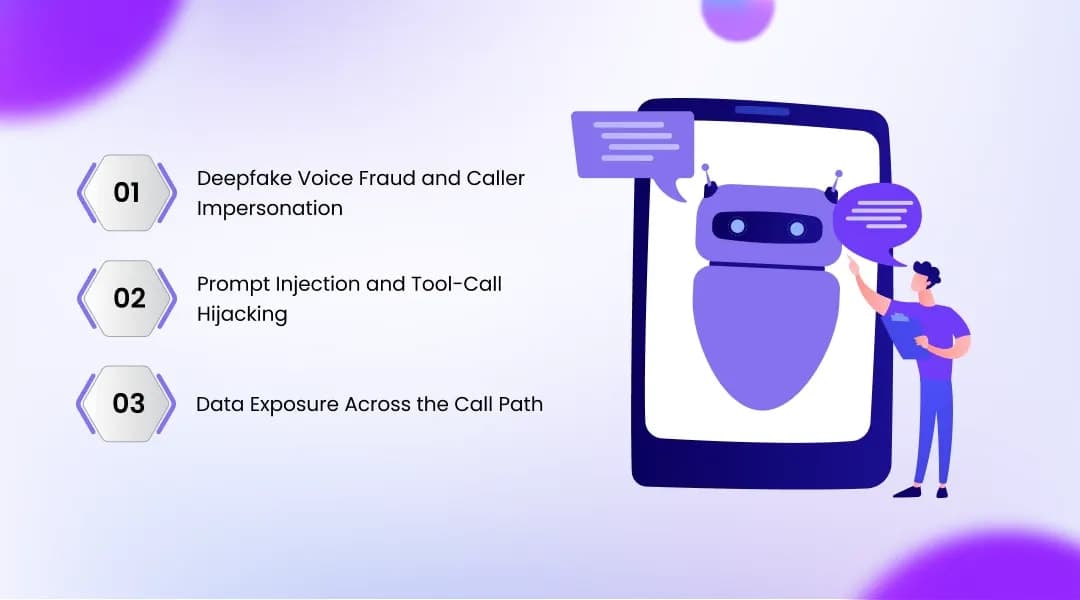
The voice AI security risks worth your attention are not exotic. They are three predictable categories, and each maps to a different layer of the system.
Voice is now a primary attack channel rather than a secondary one, and that risk grows as more enterprises are replacing traditional call centers with AI call center voice agents at a pace few security teams have caught up with. Mandiant's M-Trends 2026 report found that voice phishing was the second most common initial access vector in 2025, and the most common route into cloud environments at 23%, ahead of email phishing. Meanwhile, Gartner's AI Risk Management Survey from September 2025 found that 62% of organizations had experienced a deepfake attack in the prior twelve months.
The uncomfortable part is the economics. A convincing voice clone needs as little as three seconds of source audio to reach roughly 85% accuracy, according to McAfee's research. Your CFO's conference keynote is three seconds of source audio. So is your customer's voicemail greeting.
Voice deepfake fraud is the use of synthetic speech to impersonate a legitimate caller and pass identity verification. The mitigation is not better human detection, because humans lost that contest already. It is refusing to let voice alone authorize anything consequential.
Here is the counter-intuitive part: the most dangerous input to your voice agent may never be spoken by the attacker at all.
OWASP ranks prompt injection as LLM01, the top vulnerability in its LLM Top 10 for the third consecutive year. In a voice deployment, the high-severity version is indirect. Voice agents commonly retrieve CRM records, appointment notes, and order histories before the first conversational turn, and any field that loads into the model's context becomes a potential injection surface. An attacker who can write to a CRM notes field through a self-service portal can plant instructions that execute on a future call, with nothing suspicious happening in real time.
The consequence scales with tool access. The goal of most injections is not to make the agent say something wrong, but to make it do something wrong: book, transfer, send, update, or process. An agent with read-only knowledge base access has a bad day. An agent with payment write access has an incident.
Voice data is not just audio. When processed to identify, authenticate, or infer personal information, voice becomes biometric data under most major privacy frameworks currently in force, including India's DPDP Act and the GDPR. That reclassification changes your obligations considerably, and most teams discover it late.
The exposure problem is architectural. A single call may pass through a telephony carrier, a speech-to-text vendor, a large language model API, a text-to-speech provider, and your CRM. That is five custodians of the same biometric identifier, and your customer consented to none of them by name.
Common failure points I see in audits include:
Unredacted storage. Card numbers and health details reach long-term storage because nobody built the redaction step before go-live.
Over-broad internal access. Anyone in the ops team can pull any call recording, with no role-based restriction and no access log.
Retention drift. Recordings kept "for training" long past the purpose they were collected for, which is a direct storage-limitation violation under both GDPR and DPDP.
Undocumented sub-processors. The vendor swapped their ASR provider, and nobody updated the data processing agreement.
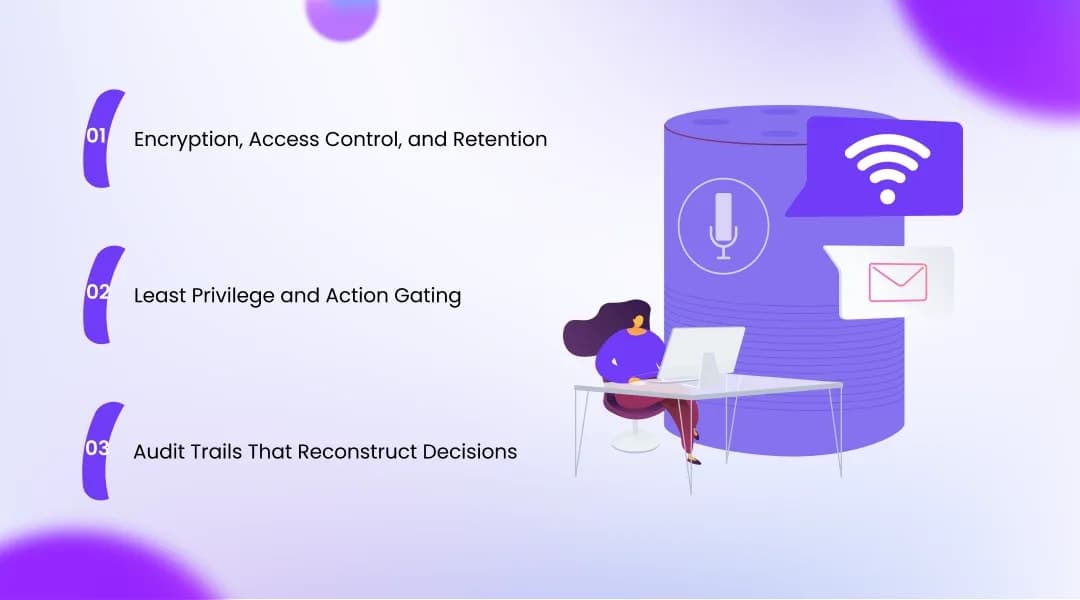
Strong enterprise voice AI security is layered, and the layers are not interchangeable. Skipping one does not weaken the system proportionally; it usually creates a clean path straight through the others.
This is the baseline, and the standards are not ambiguous. Voice data in transit between the telephony endpoint, the voice AI platform, the ASR vendor, the model API, and the CRM should use TLS 1.3 as a minimum, and audio recordings and transcripts stored at rest should use AES-256 or equivalent. If a vendor cannot state those two strings without checking, that tells you something.
Access control matters more than teams expect, because the insider path is the quiet one. Role-based permissions should govern who can hear a recording, and every access event should be logged. Retention policies should be enforced by the platform on a schedule rather than by someone remembering to run a cleanup job.
Redaction belongs in this layer too. Card numbers, health identifiers, and government IDs should be stripped automatically before anything is written to durable storage, not cleaned up afterward.
Least privilege is the highest-leverage control available in voice AI, and it costs nothing but discipline. Voice agents should only have access to the systems, data, and actions they genuinely need, because least-privilege access reduces the blast radius if a workflow is manipulated. Voice alone should not authorize sensitive transactions, account changes, or privileged actions, and high-risk workflows should use out-of-band verification, a secondary approval step, or human review before execution.
The practical version is intent tiering. Low-risk intents such as order status or appointment changes stay fast and frictionless. Medium-risk intents such as contact detail updates get light verification. High-risk intents such as credential resets, payout changes, and account recovery get a deliberate pause, and that pause is a feature.
Ask yourself which of your call intents you would be comfortable seeing on a news site tomorrow. That list is your gating map.
Most voice platforms log that a call happened and that an API was called. That is a network record, not an accountability record. For regulatory purposes, logging that a call occurred or that an API was invoked does not establish whether the agent's decision to make that call was within authorized scope, and incident investigators need to reconstruct what the agent decided and why, not just what happened at the network layer.
A usable audit trail for a voice agent includes, per call: the recording, the transcript, the consent context captured at the top of the call, the system prompt version in force at that moment, every tool call with its parameters, and the platform configuration at call time. Without the prompt version, you cannot explain a behavior six months later, because the prompt has changed forty times since.
We build this into OnDial deployments from the first pilot rather than the first audit, backed by OnDial's platform features built for enterprise-grade security, and the reason is unsentimental. Retrofitting an audit trail after an incident means the evidence you need does not exist.
AI voice agent compliance defines what is prohibited. It does not tell you where your agent will break those rules, and that difference is where most regulatory incidents are born.
Each framework covers a real thing, and none of them covers conversation design. SOC 2 is a framework from the AICPA reporting on controls relevant to security, availability, processing integrity, confidentiality, and privacy, and it takes 12 to 18 months of sustained investment to reach a Type II report, which is exactly why it functions as a meaningful vendor filter. SOC 2 Type II is an independent attestation that a vendor's security controls operated effectively over a period of time, typically twelve months.
HIPAA is stricter and more specific, particularly for any AI voice agent in healthcare ensuring HIPAA-compliant care, since the bar for protected health information sits well above general data protection rules. Voice AI agents can be HIPAA compliant when the vendor signs a Business Associate Agreement, encrypts PHI in transit and at rest, restricts access to authorized personnel, and supports verified deletion of recordings and transcripts on request. SOC 2 alone does not satisfy HIPAA; healthcare buyers need both the Type II report and a signed BAA covering the voice AI deployment specifically.
And here is the honest limitation nobody in this category likes stating: a HIPAA-certified system still violates HIPAA if the agent verbally discloses protected health information to an unverified caller, because the certificate lives in your documentation while the violation happens in the call. The same is true of PCI DSS, where the most common failure is an agent reading a card number back for confirmation rather than a storage breach. That is a design flaw, and no audit will catch it.
For any deployment touching Indian customers, voice AI data privacy obligations stack rather than substitute. The Digital Personal Data Protection Act always applies, because every voice AI deployment processes personal data, at minimum phone numbers and conversation transcripts. It governs lawful ground for processing, notice and consent, retention, opt-out, and grievance redressal. The penalty framework is not decorative: exposure runs up to INR 250 crore per breach instance, with repeat violations treated more severely.
Consent under DPDP is narrower than most teams assume. Voice consent captured during a call counts only if the purpose is specifically stated, so a blanket "by continuing this call you agree" does not clear the bar. On top of that sits TRAI's DLT framework governing whether you may place the commercial call at all, which is a separate consent regime entirely. A customer who has not opted out under TRAI has not thereby given DPDP-compliant consent for their voice data to be processed, stored, and analysed.
Data residency deserves its own conversation with your counsel. DPDP Section 16 restricts cross-border transfer to countries the Central Government notifies, and as of May 2026 no notified list had been gazetted, which much of the privacy bar reads as a practical reason to keep data in India until clarity arrives. This is an area where I will not pretend to certainty on your behalf. The rules are still trashing through 2026, and any vendor who tells you the position is settled is selling rather than advising.
This is where the abstract becomes purchasable. A useful AI voice agent vendor security checklist is short, specific, and designed to be uncomfortable.
Ask where the audio physically goes, in order, from the moment the caller speaks. Then ask which of those hops the vendor owns.
Most cannot answer cleanly, and the reason is structural rather than evasive. Most voice AI vendors do not own the PSTN side, which means buyers end up chaining multiple SOC 2 reports together to get full coverage of the call path. A vendor's Type II report may cover their orchestration layer beautifully while excluding the transcription processing, the model inference, and the carrier. The question to ask is whether the SOC 2 scope covers the actual transcription processing and storage, not just the API layer.
Draw the diagram yourself during the call. If the vendor cannot fill it in from memory, they have not thought about your risk; they have thought about their product.
Run these in a single session, in this order, and take notes on the hesitations rather than the answers:
"Show me the SOC 2 Type II report, not the badge." Standard practice is to share the report under NDA before contract signature, and a refusal to do so is a red flag, because the badge without the report is unverifiable marketing.
"Which Trust Services Criteria are in scope?" Security is always included; ask specifically whether Availability, Processing Integrity, Confidentiality, and Privacy are also covered, since all five are relevant for voice.
"What can the agent write to, and who approved that list?" Read access is a privacy question. Write access is a solvency question.
"Walk me through your identity verification gate for a high-risk intent." If there is no gate, there is no security posture, only a security document.
"How do you test for prompt injection and unauthorized disclosure before production?" Adversarial simulation should be a pre-launch step, not a post-incident one.
"What is your consent capture, logging, and erasure flow?" For Indian deployments, ask them to name the DPDP sections. The good ones can.
"Who owns the transcripts, prompts, and model outputs?" The answer should be you, in writing, with deletion certification on exit.
Two of these are enough to separate the serious vendors from the rest. In our own sales conversations at OnDial, we hand this list to prospects before they ask for it, partly because transparency is how we prefer to work, and partly because a buyer who asks hard questions early becomes a client who is still there in year three.
AI voice agent security comes down to three things worth carrying out of this article. First, the risk lives in what the agent is permitted to do, not in the voice interface itself. Second, compliance frameworks like SOC 2, HIPAA, GDPR, and India's DPDP Act cover your infrastructure and your paperwork, never your conversation design. Third, most vendors do not own their full call path, which means every security claim needs to be traced hop by hop rather than accepted as a badge.
You are no longer in the position of asking whether this technology is safe. You are in the position of asking a specific vendor to prove a specific thing, which is a question that has an answer.
If you want that traced against your actual call flows rather than a generic deck, bring OnDial your three highest-risk intents, and we will map the data path, the gating, and the DPDP consent flow for each one before anyone mentions pricing. That is the conversation we would rather have first.
COO
Ridham Chovatiya is the COO at KriraAI, driving operational excellence and scalable AI solutions. He specialises in building high-performance teams and delivering impactful, customer-centric technology strategies.
View all articles by Ridham ChovatiyaGet comprehensive answers to common questions about AI voice agents and how they can transform your customer service.
Don't let your customers wait on hold. Join thousands of businesses using OnDial to provide instant, intelligent customer service 24/7.
Can AI voice agents replace human agents? The 2026 data says no, but the real answer is more useful. See where AI wins, where it fails, and why hybrid wins.
Agentic AI vs AI voice agents confuse most buyers. Watch one real call run through three different systems, then use four sharp questions no vendor can dodge.
Learn AI voice agent CRM integration for Salesforce, HubSpot, and Zoho. Avoid costly sync errors, automate updates, and improve every customer call today. now